
Do I need to know whether I want to keep or sell?
No. Some owners already know; others simply know their current role is no longer sustainable. The first conversation is about clarifying the problem before choosing a path.
 Enduring Equity
FOR OWNERS THINKING ABOUT WHAT COMES NEXT
You may not need to sell a business you still believe in just to step back. Enduring Equity can take defined operating responsibility, strengthen the company around you, and reduce how much depends on you personally—while you retain ownership.
And if you're ready to move on, we can help you pursue a thoughtful, confidential sale.
 Defined operating responsibility
 Confidential sale support
 Owner-first clarity
Explore what matters to you
You don't need to decide what comes next before you start exploring. Begin with the question that matters most to you.
Quick answers
You don't need to have everything figured out before talking with us.
These are the questions we hear most often from business owners.No. Some owners already know; others simply know their current role is no longer sustainable. The first conversation is about clarifying the problem before choosing a path.
Potentially. For the right business and owner, EE can take defined day-to-day management responsibility while you retain ownership. You still have a defined role, decision rights, reporting, and agreed responsibilities.
Yes. If selling is the right outcome, EE can help prepare the company, selectively approach appropriate buyers, evaluate options, and support a deliberate transition.
Depending on the engagement, EE may take responsibility for day-to-day leadership and management, financial and operating systems, people processes, reporting, management cadence, and coordination with your existing team. Scope is agreed up front.
Yes. Conversations about stepping back or selling are confidential. If you pursue a sale, we do not publicly market the business. Information is shared selectively and with your permission.
Sale and operating engagements are structured separately. Sale compensation is success-based and paid if a transaction closes. Operating support is scoped and priced separately based on the business and agreed responsibilities.
Our process is designed to help you gain clarity,
not pressure. You stay in control at every step.
We look at the business, cash flow, industry, team, your current role, what you want to change, and your timing.
We focus on your goals, concerns, current operating reality, and whether EE appears to be a fit.
That may mean operating support, preparing for a sale, waiting, or deciding that now is not the right time.
Experience with teams, P&Ls, cash flow, and the practical realities behind the numbers.
Established, community-rooted businesses with real customers, employees, cash flow, and durable demand.
Compensation is tied to a defined transaction or management engagement, not a large upfront consulting retainer.
Depending on the engagement, EE can remain involved in operations and transition.
Owner dependence
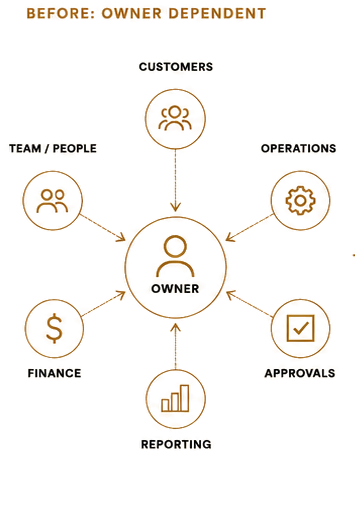
You can love what you built and still be tired of carrying so much of it.
If every important customer issue, employee problem, financial question, and operating decision eventually finds its way back to you, then the business may still depend too heavily on one person.
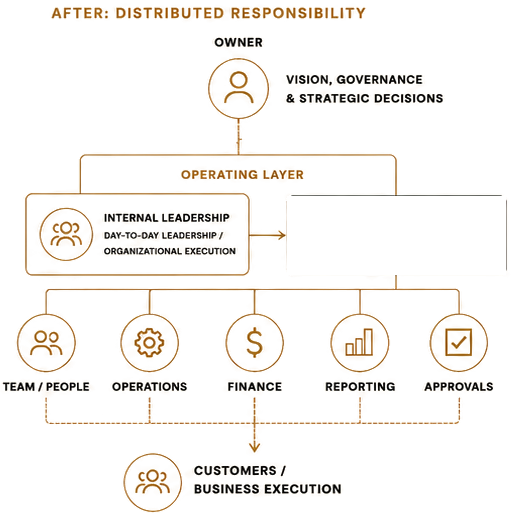 EE Operating PartnerDefined operating
Stronger systems, clearer roles, better management, reporting, and accountability can reduce dependence on one individual—and strengthen the underlying organization.
These are different problems, and they can lead to different solutions.
You do not need to know which path is right before contacting us.
You still want the asset. You still care about its future. EE can take defined operating responsibility while strengthening the organization around you and reducing how much unnecessarily depends on you personally.
Explore the Operating PartnershipYou are ready to stop owning. EE can help prepare the company, selectively approach buyers, evaluate the options in front of you, and support a deliberate handoff.
Explore the sale pathNeither path is automatically better. You do not need to choose before you contact us.
EE is not the right operating or transition partner for every company.
You do not need a perfect business.You do need a viable business and a willingness to work from reality.
Tell us about your businessWhen you're ready to transition ownership

Keeping the business is not automatically the better answer. Sometimes selling is exactly the right decision.
You may be ready to retire.
You may want liquidity.
You may want to invest your time somewhere else.
You may believe another owner is better positioned for the company’s next chapter.
Or you may simply no longer want the responsibility that comes with ownership.
Those are legitimate reasons to sell.Our job is not to talk you out of that decision.It is to help you pursue it thoughtfully.
A thoughtful sale process

We clarify your goals, timing, financial needs, and priorities for employees, customers, and your role after closing. Then we organize the key financial and operating information a serious buyer will need.

When the business is ready, we present it clearly and selectively approach qualified buyers from our network. We coordinate the information flow so you do not have to manage every conversation yourself.

Price is only one part of an offer. We help you compare price, terms, financing, contingencies, and transition expectations so you can judge the whole deal. Legal, tax, and accounting advice stays with the appropriate professionals.

Closing is not the end of the story. We help define the handoff of responsibilities, relationships, and knowledge so everyone knows what happens next. The goal is a deliberate transition, not a rushed one.
Considering a sale?
Every business is different. A rough value range can help you decide whether to explore a sale now, prepare first, or consider another path.
Directional estimate only — not a valuation or appraisal.

Complete the required inputs to see your estimated business-value range.

Financial performance, business quality, and stability.

Risk, concentration, growth consistency, and market conditions.

Preparation, timing, deal structure, and buyer diligence.
A directional range based on the financial benefit to the owner and key characteristics of the business.
Market conditions, buyer requirements, and deal structure can change the range.
Diligence may change the estimate as more information is reviewed.
A formal valuation or appraisal.
Tax, legal, accounting, or valuation advice.
This tool provides a rough, market-based range to help you get oriented. It is not a formal appraisal, valuation opinion, fairness opinion, binding offer, or guarantee of sale price. The result is based on reported market benchmarks and the information you provide. Actual value and transaction proceeds can change materially after financial review, buyer diligence, financing, deal structure, working-capital treatment, taxes, debt, transaction expenses, and other factors. Legal, tax, accounting, and valuation advice should come from the appropriate professionals.
There is no version of either path where the owner contributes nothing. The amount and type of involvement depend on the business and engagement.
PATH 1
OWNER INVOLVEMENT OVER TIME
Expect focused work up front to share information, clarify your goals, define roles and authority, establish reporting, and transition responsibilities.
After that, the goal is a clearer owner cadence rather than constant operating involvement. Your actual role depends on the business and agreed scope.
Takeaway: Front-loaded clarity. Then a defined owner cadence.
PATH 2
OWNER INVOLVEMENT OVER TIME
Information, planning, materials.
Initial dialogue and alignment.
Information requests and review.
Terms, agreements, and approvals.
Transition of responsibilities, relationships, and knowledge.
Expect periodic owner involvement through preparation, buyer conversations, diligence, negotiation, closing, and handoff.
The busiest windows are usually diligence, negotiation, and closing, and buyers will need information and some handoff from the existing owner.
Takeaway: Periodic involvement. Heavier windows at key transaction stages.
Sale and operating engagements use different compensation models.
We make those economics clear before either engagement begins.
Sale engagement
Success-based. Paid only if a transaction closes.
Information, planning, preparation.
Outreach, conversations, diligence.
A successful closing.
Compensation paid at closing.
Before we formally engage, we walk you through the fee structure so you understand how and when we are compensated.
Operating engagement
Tailored to the business and the work.
Goals, responsibilities, work to be done.
Pricing based on size, complexity, needs, and scope.
Execution with clear expectations and decision rights.
Defined reporting and review rhythm.
We define scope, expectations, decision rights, and reporting cadence up front so you understand how the engagement works and what to expect.
Enduring Equity was founded by operators who have led teams, managed P&Ls, and built real businesses. We created the firm to make ownership and transition more manageable for people who do not have the time or team to do everything alone.


Decision diligence
Yes. In an operating engagement, you retain ownership. The exact division of operating authority and owner decision-making is defined before responsibilities are transferred.
That depends on the engagement. We define decision rights up front so both sides understand what EE can decide operationally and what requires owner involvement or approval. The intent is not to create ambiguity about control.
Depending on the scope, EE may take responsibility for day-to-day leadership, operating systems, financial reporting, HR and people processes, management cadence, owner reporting, and coordination with the existing team. We do not assume every company needs the same model.
An operating engagement is not advisory-only. We may recommend changes, but the distinguishing feature is that EE can also take responsibility for implementing and carrying agreed operating work.
That is not what we promise. Owners still have ownership responsibilities, and some businesses will require more owner involvement than others. The goal is to reduce unnecessary operating dependence - not pretend ownership carries no responsibility.
It depends on the company and the path. Operating engagements generally require meaningful upfront alignment and an agreed ongoing owner cadence. Sale engagements have quieter and busier periods, with greater involvement typically required during diligence, negotiation, and transition.
For sale engagements, compensation is success-based and paid if a transaction closes. Operating engagements are separately scoped and priced according to the business and responsibilities involved.
Those decisions do not have to be permanent. If your goals change, we can revisit whether selling has become the better path.
Then we focus on selling. You do not need to explore operating support first. We can discuss readiness, timing, valuation expectations, buyer fit, confidentiality, transaction structure, and transition.
We do not publicly market the business. Information is shared selectively and with your permission as potential buyers are evaluated. We will not contact employees, customers, or vendors about a potential sale without your permission.
There is no responsible way to guarantee what will happen under every future owner or operating situation. What we can do is treat employees, responsibilities, communication, continuity, and transition as important parts of the planning process rather than afterthoughts.
Our primary focus is established, healthy, cash-flowing small businesses with real customers, teams, and durable demand. We are generally not positioned as a distressed-business turnaround service.
Yes. An operating engagement does not assume the existing team needs to be replaced. Depending on the business and agreed scope, EE may work alongside current leaders, help clarify responsibilities and decision rights, strengthen management systems, and coordinate with the people already running important parts of the company. The structure depends on the business, the team, and which responsibilities actually need to move.
No. Your records do not need to be perfect before the first conversation. We do need enough reliable information to understand the business, including revenue, cash flow, recent performance, and any major financial issues. If the records have gaps or need cleanup, identifying that early can help clarify what should happen before deeper diligence, an operating engagement, or a sale process.
No. Some owners already know exactly what they want. Others only know that their current role is no longer working for them. The first conversation is designed to understand the business, your goals, your current role, and what you want to change before deciding which path makes the most sense. That may be operating support, preparing for a sale, pursuing a sale, waiting, or deciding that now is not the right time.
We review what you shared so we can understand the business and prepare for a useful first conversation. The next step is typically a short confidential conversation focused on your goals, concerns, timing, current operating reality, and whether EE appears to be a fit. You are not committing to sell the business or hire EE by submitting the Owner Profile.
Then we should say so. The purpose of the first conversation is to gain clarity, not force an engagement. The right next step may be to prepare first, wait, pursue another path, work with a different provider, or simply decide that no change is needed right now. We would rather reach a clear “not yet” or “not us” than create an engagement that does not make sense.
No. We treat discussions about ownership, operating changes, and a potential sale as confidential. If you are considering a sale, information is shared selectively and with your permission. We will not contact employees, customers, or vendors about a potential transaction without your permission. If an operating engagement moves forward, communication with the team and other stakeholders should be planned deliberately as responsibilities and roles are defined.
Still have questions? Share them in your Owner Profile and we will address them directly in the conversation.
Tell us about your businessPrivate owner inquiry
Share enough for a thoughtful first conversation. This is not diligence, and submitting does not commit you to a sale or engagement.
Enough context to understand the business and prepare for a useful first conversation.
Typically 20–30 minutes focused on your goals, timing, current role, concerns, and the business as it actually operates.
That may be operating support, preparing first, pursuing a sale, waiting, or deciding that EE is not the right fit.
Submitting does not commit you to sell your business or hire EE.
Changing your role in a business you spent years building deserves thought.
If you are considering a sale
Work through the questions serious owners consider before pursuing a sale. Clearer thinking now leads to better options later.
Occasional practical writing on planning a sale, stepping back from day-to-day operations, preparing a business for transition, and thinking clearly about timing, value, and stewardship.
No fluff. No hype. You can unsubscribe anytime.